When something is important enough, you do it even if the odds are not in your favor.
— Elon Musk
This is the first post on my new blog. I’m just getting this new blog going, so stay tuned for more. Subscribe below to get notified when I post new updates.
The first thing you should know before you start your Software Engineering Career is that you are not in the business of coding. Erase that thought. Coding is the means by which you execute your actual business: Problem Solving.
As a Software Engineer, you are in the business of Problem Solving. Coding is just the means by which you solve the problem.
Cymmone Yancey
The Art of Problem Solving
As a Software Engineer, clients and businesses aren’t paying you just to code. They want you to be able to solve their problems by building software on their behalf. The first part of that is to find a solution to their problem. But, before you can run off and try to solve a Fortune 500 Company’s problem, you should be able to solve the problems you’ll encounter while learning about your number one tool: programming.
Learn How to Self-Learn
Self-learning is by far the most important facet of problem solving. Conducting effective searches to find information, the ability to decipher other people’s solutions, and the ability to apply that solution to your own situation/problem are all skills that will take you far when Self-Learning. In this article, we will touch on the first skill: conducting an effective search.
Note that these methods may not be the most comfortable. If you are the type of person who jumps from place to place, glazes over important contracts they’re about to sign, or has difficulty taking their time when dealing with the unknown, this will be fairly difficult for you at first. However, you will be happy that you took the time to learn these skills.
Take your time when you first start out so that you can be the most efficient Developer when you reach the employment stage.
Cymmone Yancey
Conduct Effective Searches
The first step to Self-Learning will be finding resources to learn from. Many of you will jump straight to the documentation of a programming language like Java or C++, get frustrated when you don’t understand what you’re reading, and give up on it. That’s a perfectly natural reaction for someone who is just starting out. Documentation was written from the perspective of someone who already knows how to code and just needs some more information about the language they are using. It is riddled with intimidating and technical language, so if you were a beginner trying to waltz into the documentation and come out with an answer 30 seconds later, it’s no wonder you got frustrated.
Documentation was written for people who already know how to code.
Cymmone Yancey
“Well, Cymmone, if I can’t learn the language from the documentation, what should I do?”
Google it. I’ll bet you were expecting a better answer. Honestly, that is the best advice you will ever receive. Learn how to effectively search for information, and there will be no limit to what you can learn. That being said, I do have a trick to effective searching. Let’s look at this from the perspective of a beginner:
I am just starting out. Coding seems pretty hard, but I really want to learn. I’m going to look up how to code.
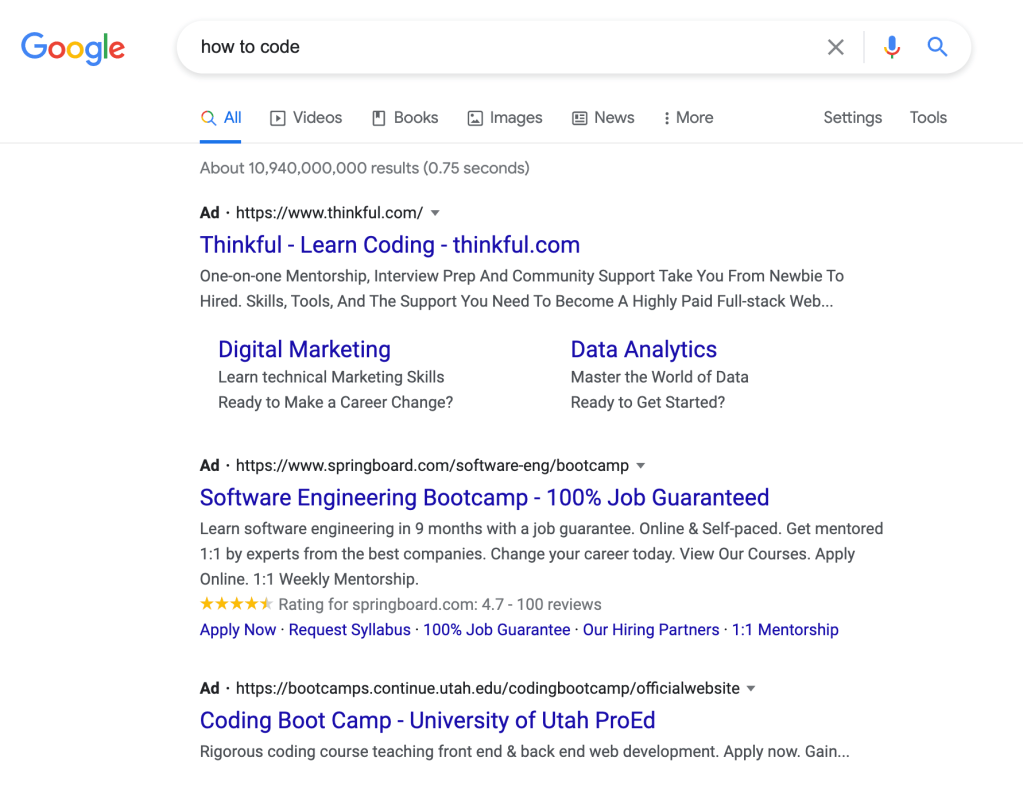
Literally typing “how to code” seems like a natural reaction for a beginner, but you’ll end up with a lot more information than you were hoping for, most of which is propaganda to start using their services.
Here is my advice to you when it comes to searching: do not type out the action you are trying to do. Instead, search for the goal you are trying to accomplish. Let’s jump back into the perspective of a beginner:
I am just starting out. Coding seems pretty hard, but right now I just want to write my first program.
See? We’ve identified their objective! If you are having a hard time figuring out your objective/goal try this formula:
I want to [thing you were trying to do] so that [expected outcome of that thing].
In this case, it would be:
I want to [learn how to code] so that [I can write my first program].
Now how do we conduct an effective search with this information? When conducting a search always remember this rule. Use:
[3-5 words describing your objective] + [the programming language you’re using]
So in our case, the search should look something like:
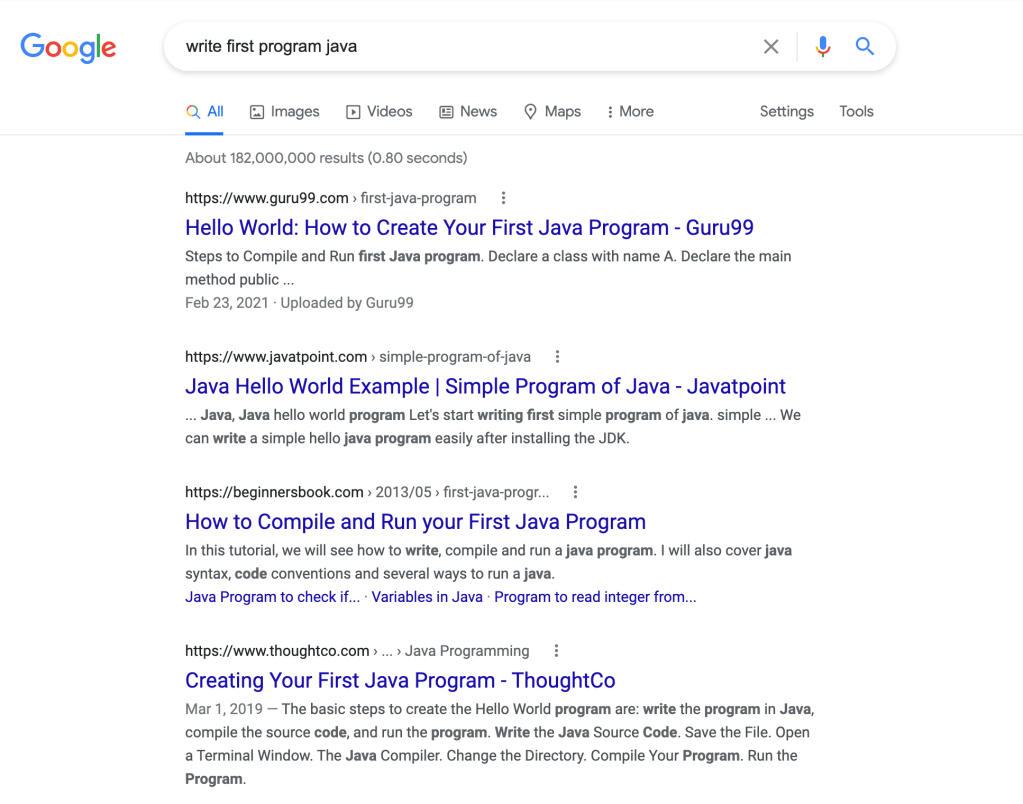
“write first program java“
Let’s do a side by side comparison of the results from our first, ineffective search (“how to code”) with our second, effective search (“write first program java”):
Not only does the “how to code” search get billions of results, but the first handful of results you see are all advertisements for services. With our “write first program java” search, we can see that we get significantly less hits and the first handful of results are all step-by-step tutorials on how to write our first Java program.
All in All
You did it! You got past the first hurdle, conducting an effective search. The next step is to be able to decipher other people’s solutions. This involves reading for comprehension and learning how to read “between the lines”, as it were, when it comes to new content. We will touch on this in our next article: “The Art of Problem Solving”.
I hope that going forward, you will have more confidence in your ability to conduct effective searches that will aid you in launching your Software Engineering Career. If you have read this article and are left with any lingering questions, contact us at thebackend.code.blog@gmail.com
If you enjoyed the read and would like to see more content like this, leave a clap or two below!
Poor communication is one of the easiest habits to develop in a virtual space. It’s hard to acknowledge the presence of those who are not physically present, so you slowly forget that you are not, in fact, working alone. You have colleagues and peers, people who have fallen into the same social lull that you have. So the big question is: How can we stay in touch?
It can be as simple as mimicking the small habits you would develop in an in-person environment. Saying hello to your coworkers when you walk into the office can be equated to sending a quick “hello” message to your team when you log on for the day. Not only does it re-invite the social interactions usually experienced in a workplace, but it lets your coworkers know that you’ve arrived to work, just as seeing you walk into the office would.
Just sending a good morning message can make all the difference!
In a physical office, people typically adopt a “lunch buddy” or two. Some teams even attend lunch together daily. In a virtual environment, this daily practice may be difficult, as some team members are likely to be in different time zones. Hosting a team luncheon once a week could be the key to re-establishing the camaraderie that once came naturally. During the team luncheon, it’s imperative to have a “no work policy”. This may cause a bit of a lull in conversation for new coworkers, so you might consider playing a game together like GeoGuessr, Skribbl.io, or even a teams game of Jeopardy. Skribbl.io has been my personal favorite and always seems to get conversation going!
Create a private room and play Skribbl.io with your peers/coworkers at lunchtime to break up the workday!
Even just putting these two tips into practice can cause a dramatic shift in your virtual workspace. In an online environment, it can be difficult to engage with your coworkers beyond the scope of your day-to-day tasks. However, you will find that going to work will actually start to feel exciting again once you take the steps necessary to reignite socializing in the workplace.
Maintaining A Balance
One of the biggest mistakes people make in a virtual workspace is overloading your time. In a physical workspace, meetings are scheduled with the time to travel in-between and the potential to go overtime in mind. However, as soon as we entered a virtual workspace, it somehow became customary to schedule meetings back-to-back with no break time in between.
“But Cymmone, it’s not like we have to walk to our next meeting. What’s the big deal? It takes like 2 seconds to open up the next meeting link, right?”
That may be true, but consider this: not only does your meeting have the potential to run overtime, but you aren’t giving yourself any time to process all of the information exchanged during your last meeting.
After a meeting, even subconsciously, your brain begins processing the information that it was introduced to and starts filing it away. This takes time and energy. Typically, our minds would handle this as we made our way to the next meeting location. However, nowadays we are giving our minds an endless backlog of information to sort through. These back-to-back meetings spare your brain no time to sort through any of the information and rather floods your mind with information until we reach a state of what people now refer to as “Zoom Fatigue”.
To prevent this, you can take initiative by blocking off the 15-30 minutes of time on your calendar that immediately precede and follow a newly scheduled meeting. This way, your coworkers can continue to simply book a meeting based on your availability, but your availability now reflects the break time necessary before and after a meeting.
All In All
All in All, if you maintain standard social interactions with your coworkers/peers at the start/end of the workday and during typical lunch breaks as well as ensure that you are not overloading your time with meetings, you will be more likely to find some enjoyment in this virtual environment.
I hope that going forward, you will have more confidence in your ability to thrive in a virtual workspace. If you have read this article and are left with any lingering questions or follow-up article suggestions, contact us at thebackend.code.blog@gmail.com
If you enjoyed the read and would like to see more content like this, leave a clap or two below!
A professional network is a group of connected peoples who have business relations. Members of a network may share valuable information on job leads, events in your field of study, or even the “next big thing” in your field. Contacts can also provide information about hiring companies, potential hires for your company/team, and potential investors or clients that have been eyeing your work. When put into perspective, it’s clear that a professional network should both be closely connected and expansive. However, most face issues in the prospect of building their network to begin with. So, where do we start?
Who Should be a Member of Your Network?
There is a common misconception for college students that your network cannot be comprised of your friends. However, in 20 years your friends are going to be the people of industry looking to hire and connect. Do not miss the opportunity to make those friendlier connections now, because those people will be more inclined to think of you in the future due to their more personal connection with you. Allowing your friends to be members of your network does not mean you should limit your network’s scope in any capacity. You should continue to incorporate fellow members of professional organizations, coworkers, and employers. If you are a member of NSBE, ACM, WiCys, or any other professional group, make connections with people who are members and have spent time in your field of interest.
Where Can You Network?
My dearest mentor and I first met during the BDPA Conference of 2019. Did that give a big enough hint? I cannot stress the importance that conferences have had in catalyzing the development of my network. As a freshman in college, going to conferences was a great way to both figure out what my focus was and find people who could help me succeed in that area. The best part about a conference is that you will not meet a single person there who is not there to network in some respect. This is perfect for those who are a little shyer on a day to day basis. In a conference setting, there is a networking opportunity with everyone you talk to, so there is no need to stress about figuring out who to talk to at all.
Some of the most valuable things you will walk away with from a conference are connections on LinkedIn. LinkedIn is a professional social media site meant to “connect the world’s professionals to make them more productive and successful” (About LinkedIn). LinkedIn has been the most ideal way to maintain long-distance network members in my networking experience. Actively posting your self-learning journey, accolades, and aspirations on LinkedIn is a great way to keep your network members engaged in your professional journey. Often, this is a key factor in whether you are thought of or recommended for an opportunity.
Moving Forward in Your Networking Experience:
I hope that going forward, you will have more confidence in your ability to network and the ways in which you are trying to build and expand your professional network. If you have read this article and are left with any lingering questions or follow-up article suggestions, contact us at thebackend.code.blog@gmail.com
Cymmone Yancey is a Sophomore Computer Science Major, Leadership Studies minor, from Provo, Utah. During her tenure at Hampton University, Cymmone has served on the E-Board of over 6 organizations. Cymmone has interned with Microsoft as an Explore Intern, is currently working for Home Depot as a Software Engineer Intern, and will be going to Seattle this Summer to work for Amazon as a Software Development Intern. In pursuit of her goal of becoming a female leader in Computer Science, Cymmone has set her sights on one day obtaining a doctorate in Computer Science.





 The BackEnd